How to Choose In-Home Senior Care: A 2026 Family Guide
Most families start the search for in home care the week after something goes wrong — a fall, a missed medication, a phone call from a worried neighbor. The pressure is real, and the choices are confusing. This guide walks through how to choose home care for a parent or spouse with confidence.
Start with the question behind the question
Before comparing agencies, get clear on what you actually need. A few honest questions:
What does a hard day look like right now — and what would make it easier?
Is the goal companionship, safety, hands-on help, or all three?
How many hours a week feel realistic to start?
Who in the family is making decisions, and who is paying?
Writing these down takes ten minutes and saves weeks of circling.
Understand what “home care” actually includes
Senior care at home generally falls into three buckets:
Companion care — conversation, meals, light housekeeping, errands, transportation, and the steady presence that prevents isolation.
Personal care — bathing, dressing, toileting, transfers, and other hands-on support.
Skilled home health — nursing, physical therapy, and medical care ordered by a physician.
Most families searching for home care near me are looking for the first two. Skilled home health is usually short-term and prescribed after a hospital stay.
The five things that matter most
After screening dozens of agencies, families tell us the same five factors decide it:
Caregiver consistency. The same one or two people, not a rotating cast.
Flexible scheduling. Look for flexible schedules that work for your family and your caregiver — long enough to build real companionship, not so rigid they can't bend around your life.
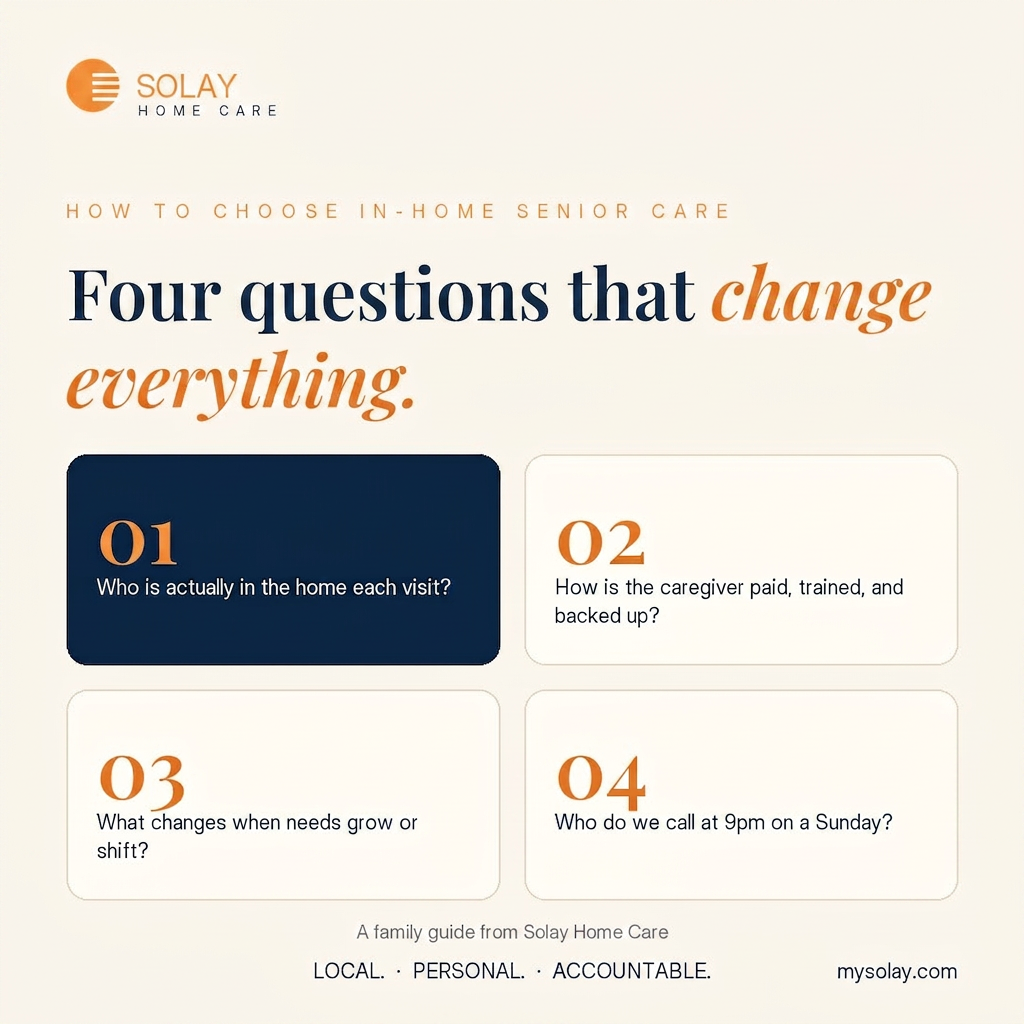
Local ownership. Local owners answer the phone on Sundays. Franchise call centers don’t.
Transparent pricing. Hourly rate, weekend rate, holiday rate, mileage — in writing, before you sign.
A real backup plan. What happens when your caregiver is sick? Get the answer in specifics, not slogans.
Twelve questions to ask every agency
Are caregivers your W-2 employees or 1099 contractors?
What is your caregiver turnover rate?
How do you match a caregiver to a client?
Who covers a shift if my caregiver calls out?
How flexible is your scheduling?
What’s your hourly rate — weekday, weekend, holiday?
Is there a contract or minimum commitment?
How are caregivers supervised?
How do you handle a complaint?
Are you licensed, bonded, and insured in this state?
Can I see a sample care plan?
Can I speak with two current families?
If any of these answers feel vague, keep looking.
Red flags worth walking away from
Caregivers classified as 1099 contractors (this shifts liability to your family).
Pressure to sign same-day.
Rigid scheduling that won't flex around your family's needs.
Vague answers about backup coverage.
No written care plan.
Reviews that mention scheduling chaos.
How much does in-home care cost in 2026?
National median is about $34/hour, or roughly $2,944/month at 20 hours per week. Florida runs about 13–18% below the national median — closer to $31/hour, or $2,684/month. For a deeper breakdown, see our 2026 Cost-of-Care Report.
A useful rule of thumb: at 40+ hours a week, assisted living usually becomes more cost-effective. Below that, home care is almost always cheaper — and lets your parent stay in the place they already know.
A simple first week
Day 1–2: Write the one-page goal. Decide hours and budget.
Day 3–4: Call three local agencies. Ask the twelve questions.
Day 5: Pick two finalists. Schedule in-home assessments.
Day 6: Compare written care plans side by side.
Day 7: Choose. Start small — two visits a week is plenty to learn what fits.
Most families wait too long, then decide too fast. Reverse it. Start small while you still have time to adjust.
Where Solay fits
Solay is locally owned companion home care in Pinellas County. Flexible schedules that work for your family and your caregiver, W-2 caregivers, no long-term contracts, and a guaranteed match — if the first caregiver isn't right, we replace them within 48 hours. If you're comparing options, we're happy to be one of the calls.
Related reading
Still comparing options? Read Elder care options explained: home care vs assisted living vs memory care for the full landscape and 2026 costs.
If you're the one providing care right now, caregiver stress: signs, causes, and where to get real support covers the warning signs and free resources that actually help.
For the full Pinellas County numbers, see the 2026 Cost-of-Care Report.