What a Good Morning Actually Looks Like: The Mind and Body Benefits of Aging at Home
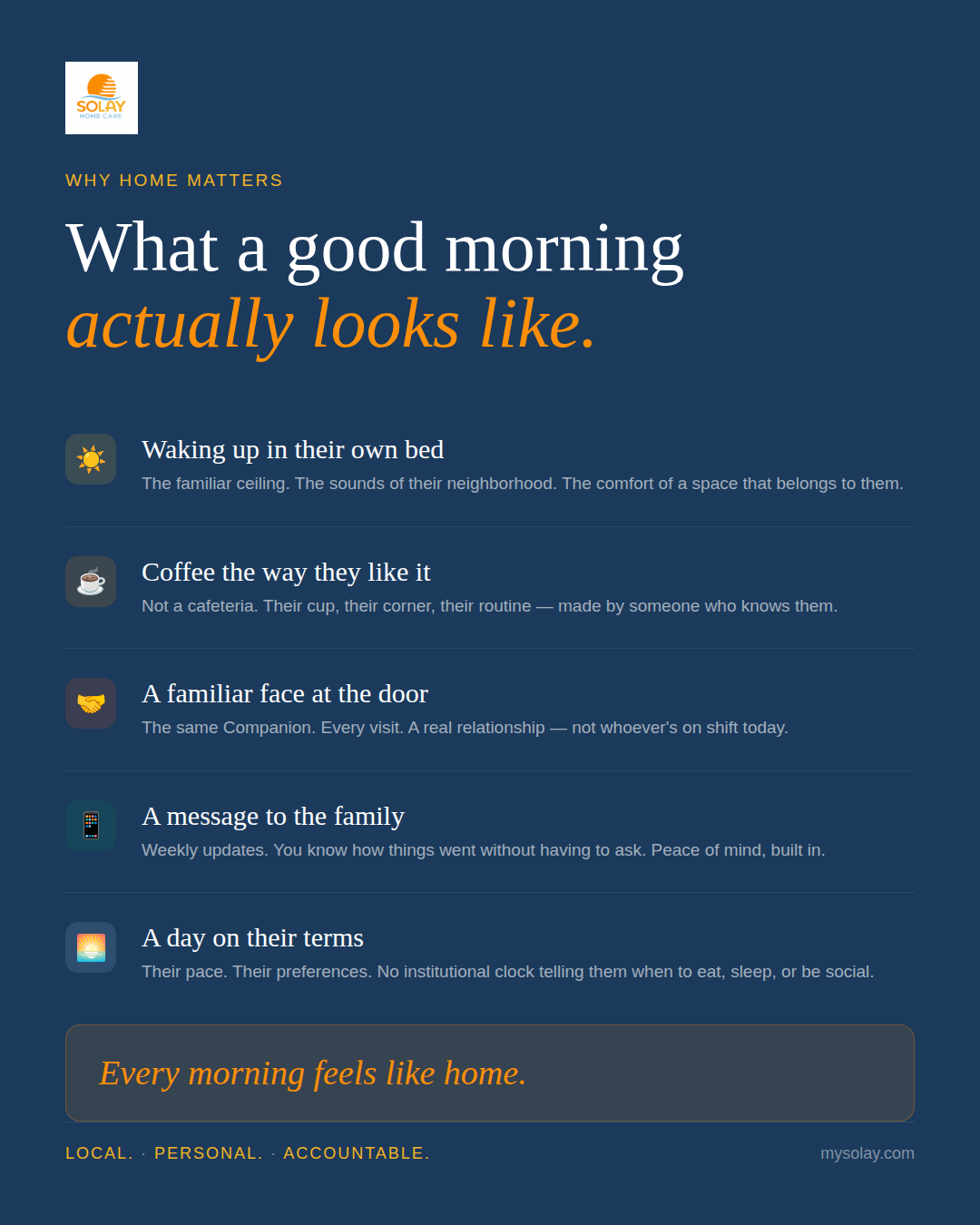
A good morning is medicine
Ask an older adult what a good day feels like, and they rarely describe a place. They describe a morning. The familiar ceiling. The smell of their own coffee. A voice they know at the door. A day that unfolds at their pace, not an institution’s.
That picture isn’t just sentimental, it’s clinical. A growing body of research shows that staying in a familiar home environment, supported by a consistent caregiver, produces measurable benefits for the brain and body of older adults. This is why 86% of adults 65+ tell AARP they want to stay in their own home as long as possible.
Here’s what a good morning at home is actually doing for them.
1. Waking up in their own bed protects sleep and cognition
Sleep is the single most powerful lever in healthy aging. Disrupted sleep is linked to higher rates of falls, depression, cardiovascular events, and accelerated cognitive decline. The bedroom matters: familiar light, familiar sounds, familiar temperature, and a familiar mattress all support deeper, more consolidated sleep cycles.
Moves to congregate settings frequently disrupt this. New roommates, hallway noise, shared bathrooms, and unfamiliar nighttime routines fragment sleep, often during the exact window of life when the brain is least able to recover from it. Staying home preserves the circadian anchors a body has spent decades calibrating.
2. Coffee the way they like it: autonomy is a clinical outcome
It sounds small. It is not. Perceived control over daily routines, when to wake, what to eat, when to rest, is one of the most consistent predictors of well-being in older adults. The landmark Langer & Rodin nursing-home studies showed that residents given even modest choices over their day had better mood, more engagement, and lower mortality than those whose routines were managed for them.
Home care preserves those choices by default. Their cup. Their corner. Their routine. A companion supports the day; they don’t run it.
3. A familiar face at the door: relationship as therapy
Loneliness is now considered a public-health risk on par with smoking 15 cigarettes a day. The U.S. Surgeon General’s 2023 advisory linked chronic isolation to a 29% higher risk of heart disease, 32% higher risk of stroke, and 50% higher risk of dementia.
The antidote isn’t “more people.” It’s trusted people, consistently. A rotating roster of strangers, common in larger facilities and lower-quality agencies, provides company without connection. A single, recurring companion who knows the dog’s name, the favorite chair, and how the coffee gets made delivers something the research calls relational continuity, and it shows up in measurable reductions in anxiety, depression, and behavioral symptoms in adults with dementia.
4. A message to the family: peace of mind is a health outcome too
The well-being of an aging parent and the well-being of their adult child are tightly coupled. Family caregivers report some of the highest stress and depression rates of any demographic in the U.S. Uncertainty, I don’t know how she’s doing today, is a major driver of that load.
Structured weekly updates from a professional companion close that loop. Families sleep better. They visit with presence instead of triage. They make decisions earlier, before a crisis forces them. That ripple effect, calmer family, more present visits, fewer 2 a.m. phone calls, feeds directly back into the senior’s own emotional baseline.
5. A day on their terms: movement, meaning, mobility
Functional decline in older adults is rarely a single event. It’s the slow erosion of small daily acts, getting up, walking to the mailbox, making lunch, calling a friend. Institutional schedules can accelerate that erosion by removing the reasons to do those things.
At home, the day still has friction in the right places. The walk to the kitchen. The trip to the garden. The grandchild who calls at 4. A good companion scaffolds those acts instead of replacing them, supporting balance, conversation, and confidence so that the senior keeps doing what they can, for as long as they can. The result is preserved mobility, preserved cognition, and a preserved sense of self.
What “home care” should actually deliver
None of the above is automatic. A home-care visit can absolutely be a stranger watching TV in the living room for four hours, that happens, and it produces none of these benefits. The mental and physical gains of aging in place depend on how care is delivered:
Consistency. The same Companion, every visit. Not whoever’s on shift.
Local accountability. A team you can reach, in your community, who knows the family.
Communication. Weekly updates to the family, not silence between invoices.
Respect for the senior’s day. Their pace. Their preferences. Their home.
When those four things are in place, a good morning stops being an accident and becomes the design of the day. That’s what we’re building at Solay, local, personal, accountable companion care for families in Pinellas County who want their parents and grandparents to keep waking up exactly where they want to be.
Every morning feels like home.