The Number That Surprises Every Family About Home Care vs. Assisted Living
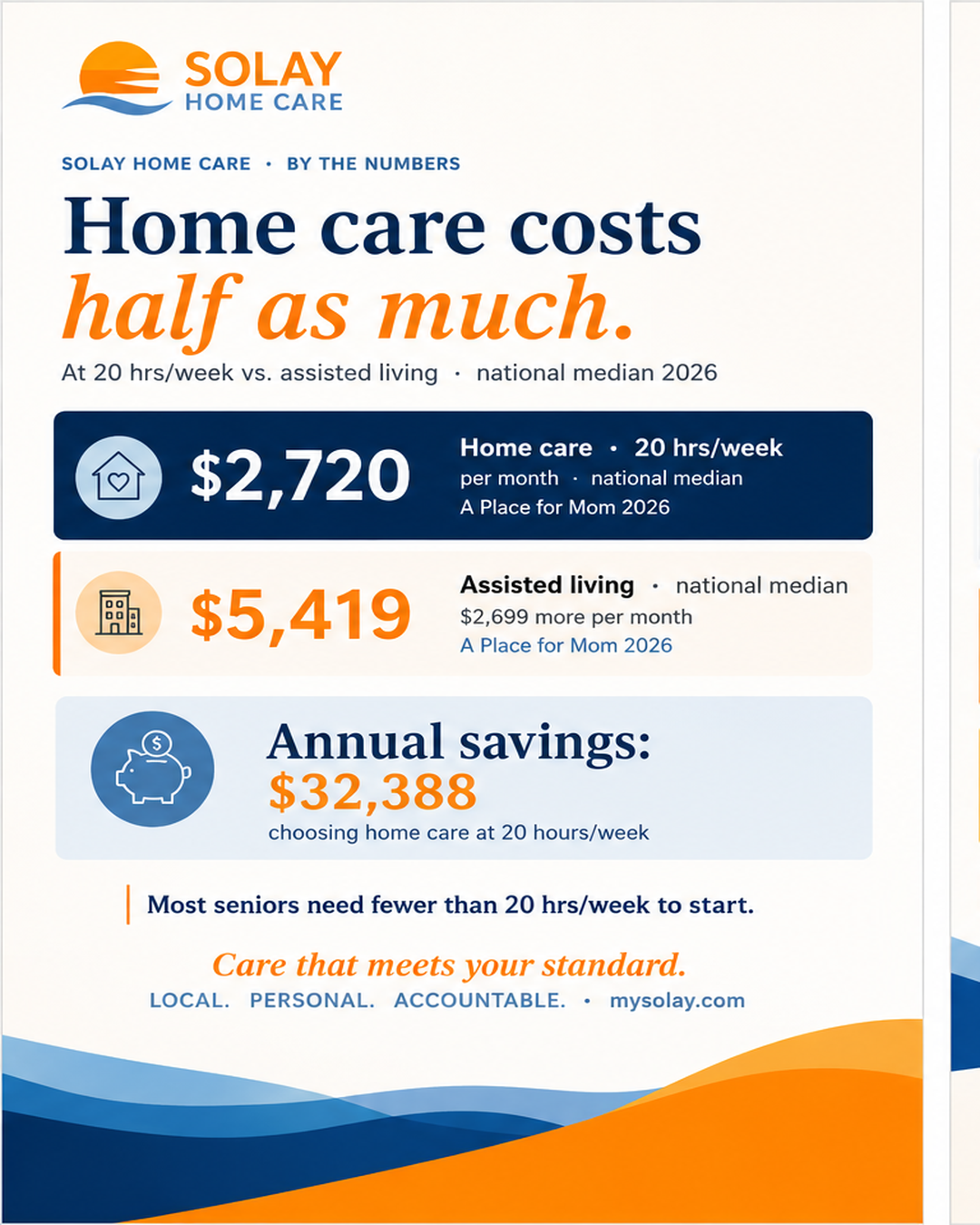
The number that surprises every family
When families first compare home care to assisted living, they expect home care to cost more. The opposite is true for most seniors who don’t yet need 24/7 supervision.
Using A Place for Mom’s 2026 national medians:
Home care at 20 hrs/week: about $2,720/month
Assisted living: about $5,419/month
Difference: $2,699 more per month for assisted living — roughly $32,388 a year
That’s the cost of choosing a facility before it’s actually necessary.
---
Most seniors need fewer than 20 hours/week to start
The biggest misconception in senior care is that you have to wait for a crisis — a fall, a hospitalization, a diagnosis — before bringing in help. By then, the only realistic option often is assisted living.
Proactive companion care looks different. It usually starts with 6–12 hours a week: a few visits for meals, medication reminders, light housekeeping, transportation to appointments, and genuine companionship.
At those hours, home care costs a fraction of the $2,720 figure above — and it does something a facility can’t: it keeps the rhythm of your loved one’s life intact.
---
Why starting sooner extends time at home
Aging in place isn’t just about cost. It’s about trajectory. The earlier consistent support starts, the longer independence lasts.
Falls are the #1 reason seniors transition to assisted living. A caregiver present for higher-risk activities — bathing, stairs, evening hours — helps prevent the event that forces the move.
Medication mistakes compound quickly. A companion who knows the routine catches missed doses before they become ER visits.
Isolation accelerates cognitive decline. Regular human connection is one of the most under-rated forms of preventive care.
Small home changes get made. Grab bars, better lighting, decluttered walkways — the things adult children mean to do but rarely have time for.
Families who start with a few hours a week often keep their parent home five or more years longer than families who wait. That changes the math entirely.
---
The real cost comparison over time
Consider two paths for the same 78-year-old:
Path A — Wait for a crisis, then assisted living.
Five years at $5,419/month = $325,140, not counting annual increases (typically 5–8%).
Path B — Start proactive home care at 10 hrs/week, scale as needed.
Five years averaging roughly $1,800–$2,800/month = $108,000–$168,000 — and your loved one is still home.
Even if the home care plan eventually grows to 20+ hours/week, the cumulative cost rarely catches up to a facility, because you only pay for the hours you actually need.
---
What “start sooner” actually looks like
You don’t need a diagnosis to begin. Good signals to bring in a few hours of help:
A parent who is managing, but the household clearly takes more effort than it used to
An adult child traveling 30+ minutes to handle errands or appointments
A recent change — a spouse’s passing, a medication adjustment, a minor fall
Anyone saying “I’m fine” a little too often
Starting with two visits a week establishes the relationship while it’s still easy. The caregiver becomes a familiar presence, not a stranger introduced during a stressful transition. When more hours are eventually needed, the foundation is already there.
---
Care that meets your standard
Solay builds in-home care around three principles: local, personal, accountable. Caregivers you actually meet. Visits you can verify. A model that recognizes companions as professionals worth keeping — which is why your loved one keeps the same person, week after week.
The most expensive decision in senior care is usually waiting too long to make a small one. A few hours a week, started early, protects independence, family savings, and the place your parent calls home.
Cost figures: A Place for Mom, 2026 national median pricing. Home care figure based on 20 hrs/week at the national median hourly rate.