Solo Aging: 1 in 10 Adults Over 50 Are Aging Alone — and Why That Should Change How We Design Care
There's a quiet assumption baked into how the U.S. handles aging: someone will be there. A spouse who knows the medications. An adult child who lives twenty minutes away. A daughter-in-law who picks up when the hospital calls at 9 p.m. For a growing share of older adults, none of that is true — and the systems around them still act like it is.
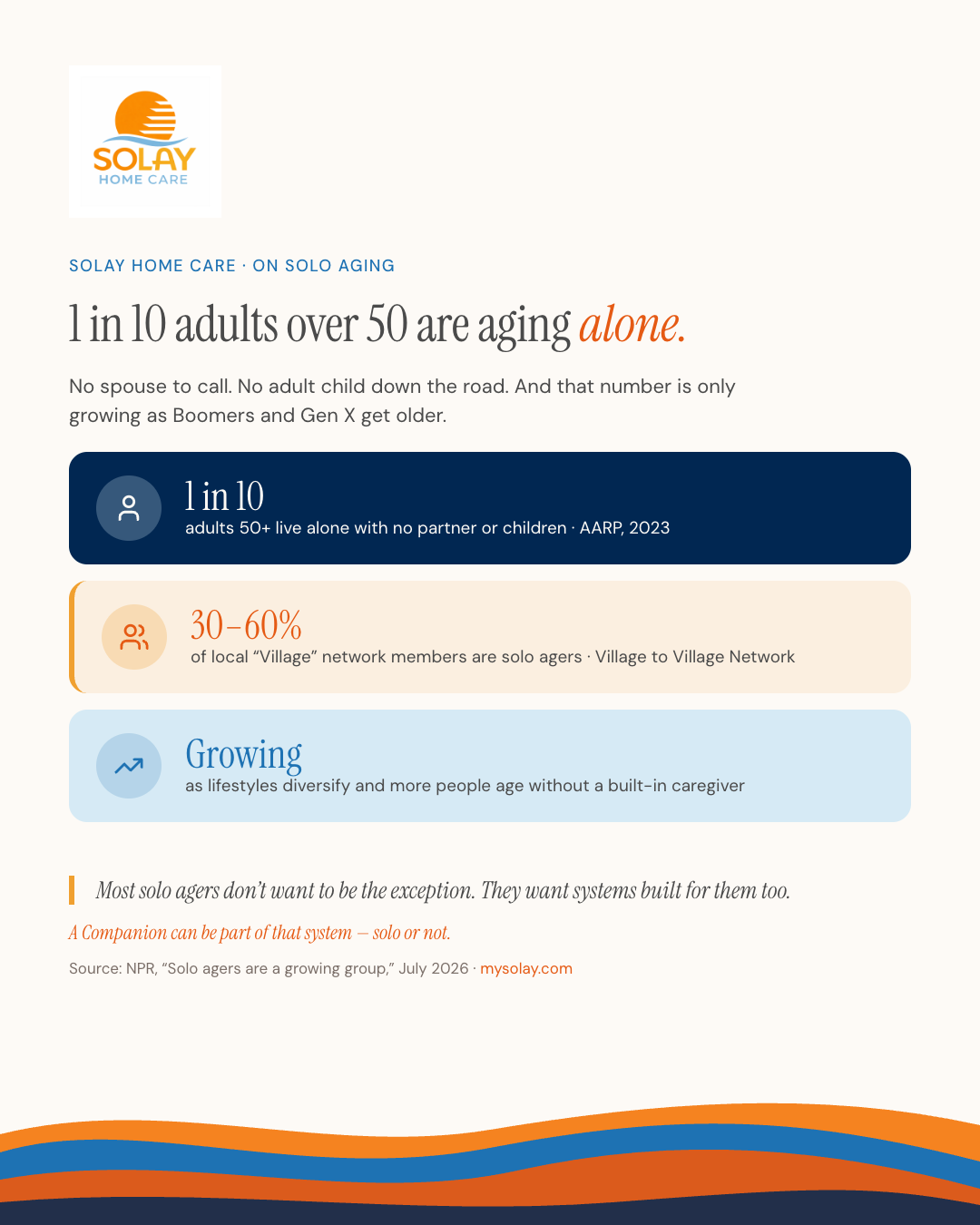
According to AARP, roughly 1 in 10 adults over 50 are aging without a partner or children. In some local "Village" support networks, solo agers make up 30–60% of members. NPR recently called them "a growing group" — and the demographics agree. As Boomers and Gen X get older, this isn't an edge case anymore. It's a large, quiet slice of American life.
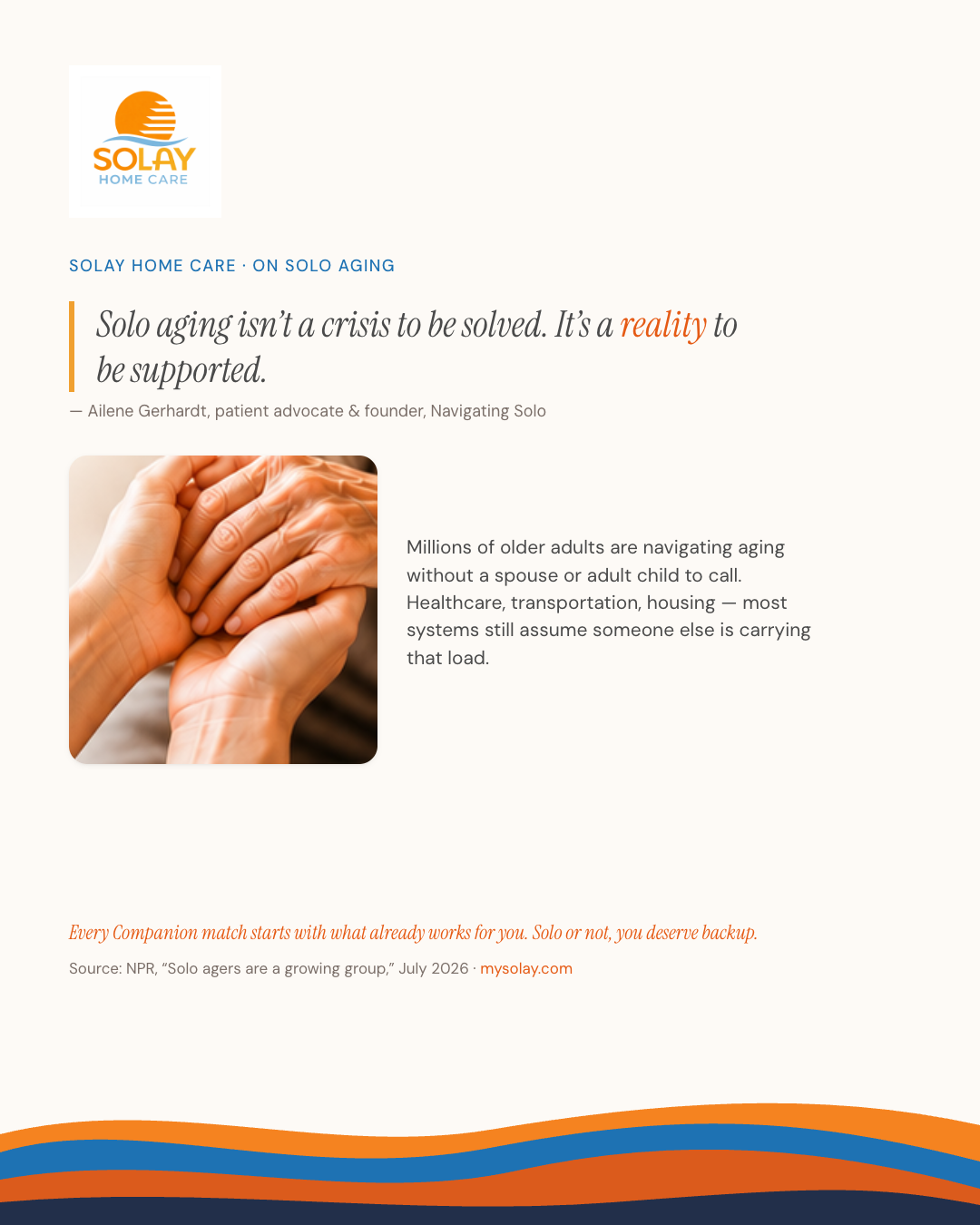
Solo aging isn't a crisis. It's a reality.
The framing matters. Ailene Gerhardt, a patient advocate and founder of Navigating Solo, puts it plainly: "Solo aging isn't a crisis to be solved. It's a reality to be supported." Most solo agers aren't in distress. They're capable, private, often deeply independent people who have — by circumstance or by choice — built lives that don't route through a nuclear family.
What they're up against isn't loneliness so much as infrastructure. Healthcare intake forms ask for an emergency contact and a person to authorize treatment. Discharge planners hand you two pages of instructions and assume someone is going to read them with you. Transportation, housing, and follow-up care all quietly rely on a helper who may not exist. That's the real gap.
The three things every solo-aging plan needs
1. A named coordinator who can be called
Not a phone tree. Not "whoever picks up." One human being — a Guide, a care manager, an aging life professional — who knows your situation, has your paperwork on file, and can return the call when a pharmacy has a question or a hospital wants to discharge you on a Tuesday afternoon. Solo agers benefit more from this role than anyone else, because there's no default family member playing it.
2. A consistent Companion for the hard windows
A few hours, in the same window, with the same person — that's the difference between "someone came to my house" and an actual support relationship. For solo agers, consistency matters twice as much: the Companion isn't just help, they're a second set of eyes on what's changing week to week, and often the first person to notice when something is off.
3. Paperwork filed before it's needed
Healthcare proxy. Durable power of attorney. Advance directive. A named emergency contact — even a friend, a neighbor, or a professional advocate. These are cheap, unglamorous, and enormously protective. Without them, the default decision-maker for a solo ager in a hospital hallway is a stranger in scrubs.
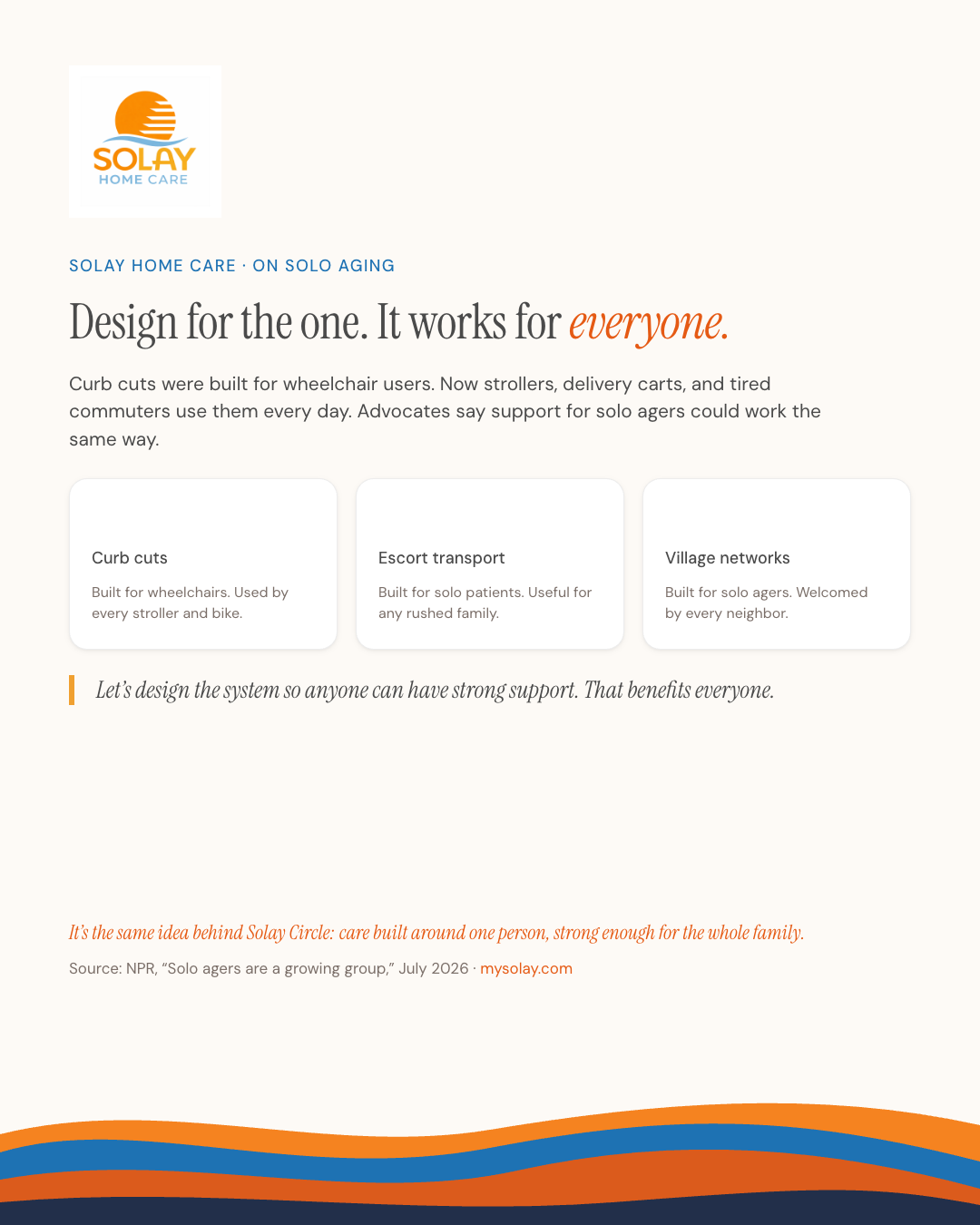
Design for the one. It works for everyone.
Curb cuts were built for wheelchair users. Now strollers, delivery carts, and tired commuters use them every day. Advocates for solo agers make a similar point: if you design a care system so a person without a built-in family can navigate it with dignity, you've built something that works better for everyone — including families who are stretched thin, sandwich-generation adults, and older couples where one partner is already the primary caregiver for the other.
What good solo-aging home care actually looks like
Same Companion, on purpose. Not a rotating cast. A relationship you can rely on and a person who notices change.
One named Guide who holds the whole picture — medical, household, legal — and can be reached between visits.
An emergency plan on paper: who to call, in what order, with what authority, before something goes wrong.
Coordination with your circle — the friend, the neighbor, the advocate, the professional. Solo doesn't mean alone; it means the network has to be built deliberately.
Space for autonomy. Solo agers, more than most, have a strong sense of how they want to live. Good care protects that instead of overriding it.
How Solay supports solo agers
At Solay, every client gets one Guide who knows their situation, and a Companion matched and kept consistent on purpose. For solo agers, that structure isn't a nice-to-have — it's the whole point. Someone knows you. Someone shows up. Someone picks up the phone. We serve St. Petersburg and Pinellas County, Florida, and most solo-aging clients start with just a few hours a week — enough to build a real relationship and cover the parts of the week that matter most.
Every Companion match starts with what already works for you. Solo or not, you deserve backup.
Source: NPR, "Solo agers are a growing group," July 2026; AARP, 2023; Village to Village Network.